Blog

💸 Kraków Prices in 2026: Coffee, Beer, Vodka, Taxi & Dining (Without Crying)

Kraków still has a reputation for being “cheap.” And yes… compared to London or Amsterdam, your wallet will feel like it’s on a spa weekend. But let’s be honest — 2026 Kraków is not the dirt-cheap paradise it once was.

Prices have crept up. Tourists have multiplied. Inflation did its thing.

Still, if you play your cards right, you can live like a king… or accidentally spend like one.

Let’s break it down 👇


☕ Coffee: From Budget Brew to Hipster Liquid Gold

  • Cheap coffee (local bakery / milk bar): 8–12 PLN (€2–€3)
  • Normal café (Old Town): 12–18 PLN (€3–€4.50)
  • Specialty coffee (third-wave hipster heaven): 18–25 PLN (€4.50–€6)

💡 Reality check:
Kraków has gone full “coffee culture.” You’ll find places that treat beans better than most people treat their houseplants.

👉 Want to save? Step 2 minutes away from the Main Square. Prices drop instantly.


🍺 Beer: Still Affordable… If You Avoid Tourist Traps

  • Cheap beer (local pub / outside center): 10–14 PLN (€2.5–€3.5)
  • Standard bar (Old Town): 14–20 PLN (€3.5–€5)
  • Craft beer / trendy spots: 20–30 PLN (€5–€7.5)

💡 Pro tip:
If the waiter speaks 5 languages and hands you a laminated menu with photos… congrats, you’re paying tourist prices.


🥃 Vodka: Because You’re in Poland, Obviously

  • Shot in a local bar: 8–12 PLN (€2–€3)
  • Shot in tourist area: 12–18 PLN (€3–€4.5)
  • Fancy vodka / cocktail bar: 20–40 PLN (€5–€10)

💡 Fun fact:
In Kraków, vodka is not just a drink — it’s basically a cultural handshake.


🚕 Taxi: Cheap… Until It’s Not

  • Starting fare: ~8–10 PLN (€2–€2.5)
  • Per km: 3–4 PLN (€0.75–€1)
  • Airport to Old Town: 90–120 PLN (€20–€28)

💡 Hard truth:
Taxis are generally cheap, but random street taxis near tourist hotspots can still “miscalculate” your route.

👉 Want to avoid taxis altogether (and honestly, you should)?
Check out this guide:
Is Kraków actually walkable or are we walking into a trap?

Spoiler: walking is often faster, cheaper, and way more enjoyable.


🍽️ Eating Outdoors: Cheap vs “Did I Just Pay WHAT?”

🥟 Budget Option (Milk Bars / Simple Restaurants)

  • Main dish: 20–35 PLN (€5–€8)
  • Full meal: 30–50 PLN (€7–€12)

💡 Expect pierogi, soups, and comfort food that tastes like someone’s grandmother made it (because she probably did).


🍕 Mid-Range Restaurant (Outdoor Seating in Old Town)

  • Main dish: 40–80 PLN (€10–€18)
  • Dinner with drink: 60–120 PLN (€14–€28)

💡 This is where most tourists land. Solid food, nice vibe, slightly inflated prices.


🍷 Luxury Dining (Yes, Kraków Has This Too)

  • Main dish: 90–180 PLN (€20–€40)
  • Dinner with wine: 150–300+ PLN (€35–€70)

💡 White tablecloths, artistic food, and portions that may or may not emotionally satisfy you.


💡 Want to Spend as Little as Humanly Possible?

Then you’ll want to read this survival guide:
👉 How to survive Kraków on a budget (museum traps, free days, and the great water debate)

Because yes… paying for bottled water in Kraków can feel like a personal betrayal.


🧠 Final Thoughts: Cheap or Expensive?

👉 Compared to Budapest: very similar (sometimes slightly more expensive in tourist areas)
👉 Compared to Berlin: cheaper
👉 Compared to London: laughably cheap

But here’s the truth:

  • Kraków can be cheap
  • Kraków can be expensive
  • And you decide which one you experience

😄 The Golden Rule

If you sit on the Main Square, order cocktails, and take taxis everywhere…
💸 you’ll spend like you’re in Paris.

If you walk, eat local, and avoid tourist traps…
🍻 you’ll feel like you’ve hacked the system.

And honestly? That’s half the fun.
🐣 Opening Times in Krakow During Easter – What’s Open, What’s Closed, and What You Can Actually Do

Thinking about visiting Krakow during Easter and wondering if you’ll be walking through a lively Old Town… or just window shopping past closed doors? Let’s clear it all up 👇

Poland takes Easter seriously—like really seriously. But that doesn’t mean your trip will be boring. Quite the opposite. You just need to know the rhythm of the city during the holiday.


🕰️ The Big Question: What’s Open in Krakow During Easter?

Let’s break it down day by day, so you don’t end up hunting for ketchup at 9 PM on Easter Sunday (spoiler: that won’t go well 😄).

✝️ Good Friday

  • Not an official public holiday in Poland
  • Shops: Mostly open
  • Supermarkets: Open (sometimes shorter hours)
  • Museums: Open as usual
  • Restaurants & cafés: Open

👉 Translation: This is a great sightseeing day.


🧺 Holy Saturday

  • A unique cultural day (you’ll see locals blessing Easter baskets at churches 🥚)
  • Shops: Open, but often close early (around 2–4 PM)
  • Supermarkets: Open (shorter hours)
  • Museums: Mostly open
  • Restaurants: Open

👉 Pro tip: Do your shopping early—this is your last “normal” day.


🐣 Easter Sunday

  • The quietest day of the year
  • Shops: ❌ Closed
  • Supermarkets: ❌ Closed
  • Museums: Mostly closed (with a few tourist exceptions)
  • Restaurants: ✔️ Some open (especially in Old Town, but limited)

👉 Expect peaceful streets, family lunches, and a very calm atmosphere.


💦 Easter Monday (Śmigus-Dyngus)

  • Yes… this is the famous “water fight day” 💦
  • Shops: ❌ Closed
  • Supermarkets: ❌ Closed
  • Museums: Mixed (many still closed)
  • Restaurants & cafés: ✔️ More open than Sunday

👉 You might get splashed. Consider it a free cultural experience.


🛍️ So… Will You Starve?

No 😄 But you do need to plan.

  • Stock up on snacks and essentials on Friday or Saturday
  • Book restaurants in advance for Sunday
  • Stay somewhere central—more places stay open in tourist areas

🏛️ What About Museums and Attractions?

Here’s the honest answer:

  • Friday & Saturday: Great for museums and sightseeing
  • Sunday: Many closed (but walking around Krakow is still magical)
  • Monday: Slowly reopening

Want ideas for what to see? Check out the best highlights on the 👉 Krakow attractions page


🕯️ Can You Visit Auschwitz During Easter?

Yes—but plan ahead carefully.

The Auschwitz-Birkenau Memorial and Museum is:

  • Open most days during Easter
  • Sometimes with reduced hours on Easter Sunday or Monday

⚠️ Important:

  • Tickets sell out quickly (especially during holidays)
  • Guided tours are strongly recommended

👉 You can read more and plan your visit here:
Auschwitz concentration camp visitor guide


🧂 What About the Wieliczka Salt Mine?

Good news!

The Wieliczka Salt Mine is:

  • Open throughout Easter
  • One of the safest bets for a holiday activity

👉 Just like Auschwitz:

  • Book in advance
  • Expect crowds

👉 Full details here:
Wieliczka Salt Mine visitor info


🌸 Easter Markets in Krakow

If you’re lucky with timing, Krakow’s Easter markets are a huge highlight.

Think:

  • Handmade crafts 🧺
  • Traditional food 🍰
  • Colorful decorations 🌷

👉 Explore what’s on here:
Krakow Easter markets and events


🌍 How Does Krakow Compare to Other Cities?

If you’re planning a multi-city trip, Krakow is actually more closed during Easter than many Western European cities.

👉 For comparison, check out how things work in Prague here:
Opening times in Prague during Easter – what to expect

👉 Short version:

  • Prague = more open
  • Krakow = more traditional

😎 Final Thoughts (And Survival Tips)

  • ✔️ Friday = sightseeing day
  • ✔️ Saturday = shopping + early dinner
  • ❌ Sunday = chill, walk, eat where you can
  • 💦 Monday = avoid water ambushes

Krakow during Easter isn’t about rushing between shops—it’s about atmosphere, traditions, and slowing down a bit.

And honestly? Walking through the Old Town on a quiet Easter Sunday, with church bells echoing and fewer crowds… that’s a travel moment you won’t forget.


👉 Want more inspiration for your trip? Explore the full 👉 Krakow Guide

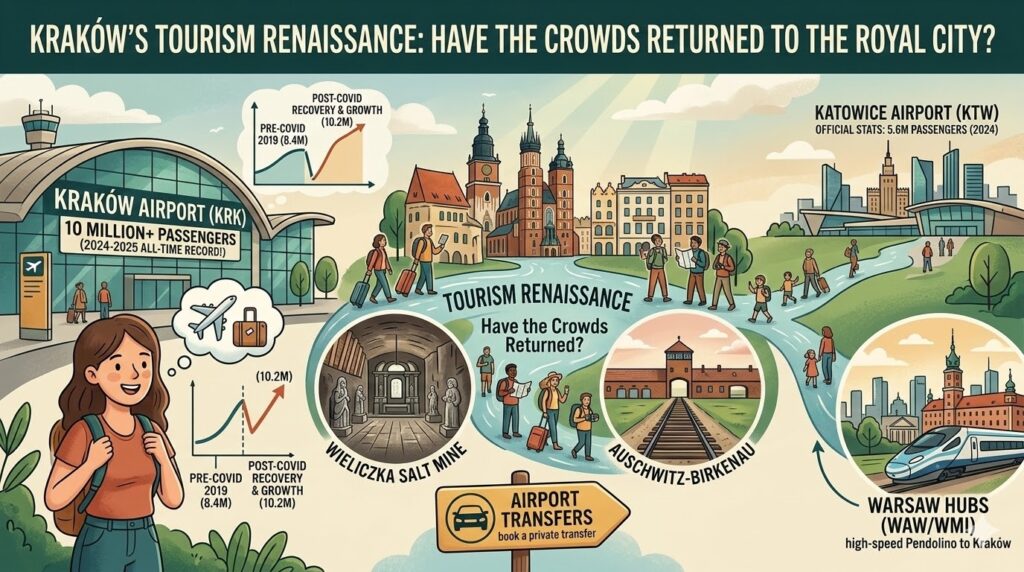
Kraków’s Tourism Renaissance: Have the Crowds Returned to the Royal City?

Kraków, the historic jewel of Poland, has long been a magnet for global travelers. With its perfectly preserved medieval core, a castle that looks plucked from a storybook, and a poignant, layered history, it represents the cultural heart of the nation. However, like every major European destination, the city’s tourism industry was brought to a standstill in 2020.

As we move through 2026, the question on everyone’s mind—from local hoteliers to international tour operators—is simple: Are the tourists back to pre-COVID levels, or has the landscape of Polish travel permanently shifted?

The Enduring Allure: Why They Come

The reason for Kraków’s popularity hasn’t changed. The city serves as the gateway to some of the most significant sites in Central Europe. Two attractions, in particular, continue to drive massive passenger inflows:

  • The Wieliczka Salt Mine: An underground labyrinth of salt-carved chapels and emerald lakes. For those planning a visit, exploring the Wieliczka Salt Mine remains a top priority for nearly every arrival.
  • Auschwitz-Birkenau: A site of immense historical gravity. Millions of people travel to Kraków specifically to pay their respects and learn at the Auschwitz-Birkenau Memorial and Museum, making it a cornerstone of the region’s educational tourism.

The Numbers: John Paul II International Airport (KRK)

To see if the city has truly recovered, we must look at the gates of the city: Kraków Airport in Balice. In 2019, the airport set a staggering record, handling roughly 8.4 million passengers. It was a peak that many thought would take a decade to reclaim.

However, the 2024 and 2025 data tells a surprising story of resilience. By the end of 2024, Kraków Airport didn’t just meet its pre-pandemic numbers; it surpassed them, hitting over 10 million passengers for the first time in its history. As of early 2026, the trajectory remains upward. The “COVID gap” has been officially closed, replaced by a new era of expansion fueled by both low-cost carriers like Ryanair and Wizz Air, and the return of legacy airlines.

For travelers landing today, navigating the final leg of the journey is the next step. You can find detailed information on Kraków airport transfers and private bookings to ensure a smooth transition from the terminal to the historic Old Town.

The “Shadow” Gateways: Katowice and Beyond

While Balice is the primary hub, it isn’t the only way tourists reach Kraków. A significant portion of “Kraków tourists” actually land at Katowice Airport (KTW), located about 90 kilometers away.

Katowice has carved out a niche as the “charter and low-cost” alternative. In 2024, Katowice Airport handled over 5.6 million passengers, a significant portion of whom utilized the direct shuttle buses to Kraków. When you combine the record-breaking stats of Kraków with the official Katowice Airport statistics, it becomes clear that the total number of people entering the Lesser Poland and Silesian regions is higher than it ever was in 2019.

Additionally, the Warsaw hubs (WAW and WMI) contribute to the tally. With the high-speed Pendolino train connecting Warsaw to Kraków in just over two hours, many international travelers from North America and Asia land in the capital but spend the bulk of their holiday—and their budget—in Kraków.

Is the Tourism “Vibe” Different?

While the numbers are higher, the way people visit has changed. In 2019, Kraków was heavily reliant on the “Stag and Hen” weekend market. In 2026, there is a visible shift toward “quality over quantity.”

The city has seen a rise in:

  1. Digital Nomads: Travelers staying for weeks rather than days, utilizing Kraków’s growing tech infrastructure.
  2. Cultural Deep-Dives: Increased interest in the Jewish Quarter (Kazimierz) and the city’s burgeoning culinary scene, which has gained international accolades.
  3. Regional Exploration: More tourists are using Kraków as a base to visit the Tatra Mountains in Zakopane, diversifying the impact of their visit.

The Competition: Prague and Budapest

Kraków remains in a tight “Triple Threat” competition with Prague and Budapest. While Prague often feels the strain of over-tourism more acutely, Kraków has managed to balance its growth relatively well. The city’s infrastructure, including the expanded airport terminal and improved rail links, has allowed it to absorb the 10-million-passenger milestone without the same level of “tourist fatigue” seen in other European capitals.

Conclusion: A Full Recovery and Beyond

Are tourists coming to Kraków like they did before COVID? No—they are coming in even greater numbers. The combination of world-class historical sites, a favorable exchange rate for many Western visitors, and a modern, efficient airport has turned Kraków from a “rising star” into a permanent “superstar” of European travel.

Whether you are descending into the depths of a salt mine or walking the quiet paths of Auschwitz, you will be joined by millions of others who have rediscovered the magic of Poland. The recovery is not just complete; it is the foundation for a new, record-breaking chapter in Kraków’s long history.